
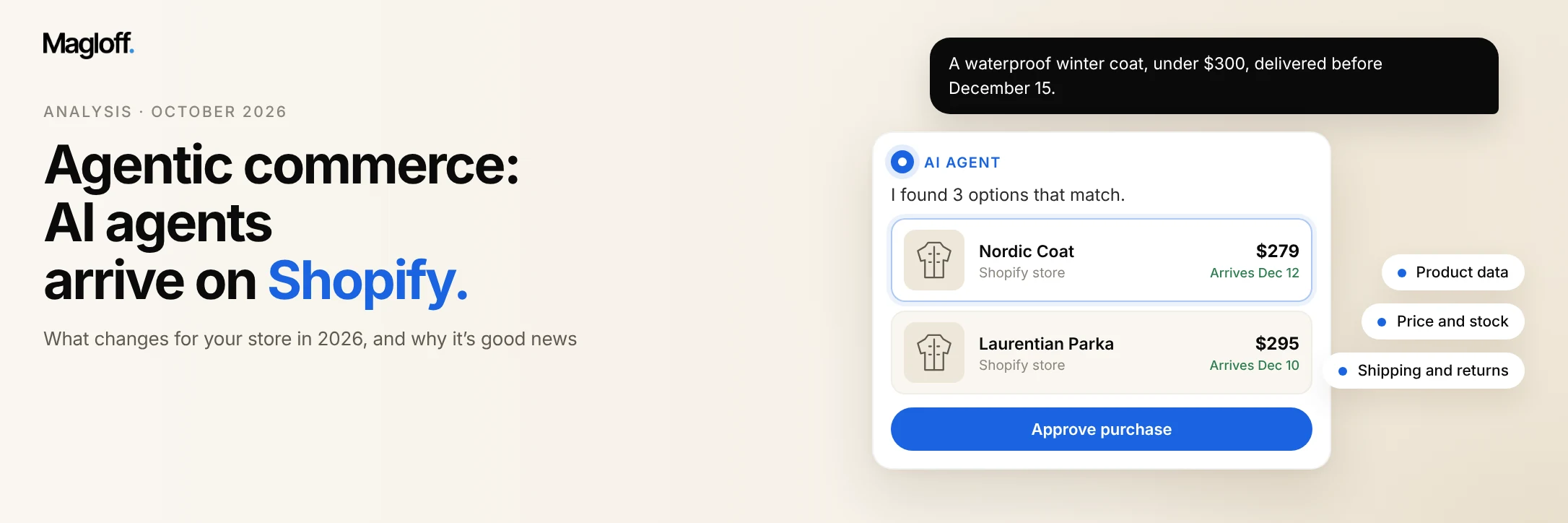
Picture a shopper in Quebec City. She types to her AI assistant: “Find me a warm, waterproof winter coat under $300, delivered before December 15.” She doesn’t visit a single site. The agent compares dozens of offers, keeps three, checks delivery times and offers to pay. She confirms.
This is no longer a vision of the future. The big platforms have been building it for a year, and Shopify just opened it to every store with its Fall ’26 Edition. It’s called agentic commerce. Here is what it is, why it matters now, and what Shopify’s new features change for your store.
What is agentic commerce?
Agentic commerce is online shopping partly handed over to an AI agent. An agent doesn’t just answer a question: it acts. It searches for products, compares offers, fills the cart and prepares the payment. The shopper approves.
The distinction matters. A search engine gives you links. A conversational AI gives you an answer. An agent does the legwork for you. In practice, an agentic purchase happens in four steps.
- 01
The shopper states a need
In plain language, with constraints: budget, size, use, delivery date.
- 02
The agent queries catalogues
It reads structured data: titles, attributes, prices, stock, shipping, return policy. Not your layout.
- 03
It compares and recommends
Only a few products, picked for relevance, price, delivery and trustworthiness.
- 04
The shopper approves
In the conversation or on your store. The order lands in your Shopify admin like any other.
How does an AI agent choose a product?
An agent doesn’t look at your banner or your lifestyle photos. It reads data: the product title, its attributes, price, stock, delivery times, return policy, reviews. The more complete and consistent that information is, the more confidently it can recommend your product.
An agent doesn’t see your homepage. It reads your data.
Shopify sees it in its own numbers: AI search built on its structured catalogue converts twice as well as AI search relying on scraped page data, and half of AI-referred sessions land directly on a product page1. Meanwhile, Adobe estimates that about 34% of product pages on US retail sites can’t be properly accessed by AI2.
Why does it matter now?
Because AI traffic is no longer marginal, and it is far better quality than expected.
AI-driven traffic and orders on Shopify stores, year over year1
conversion for AI-referred visits compared with other visits3
revenue per visit from those same visitors3
in US retail sales could run through agents by 2030 (high-end projection)4
The first figure comes from Shopify, which announced in August that AI-driven traffic and orders had tripled year over year across its stores1. The next two come from Adobe, which analyses more than a trillion visits to US retail sites: in July 2026, AI-referred visits converted 60% better than other visits, for the eleventh month in a row3. The last one is a projection from McKinsey4: an order of magnitude, not a promise.
For a merchant, four things change.
Visibility
Being picked by an agent no longer depends only on SEO or ads.
Comparison
Price, shipping and returns are compared in a second, offer by offer.
Customer relationship
Part of the journey happens off your site, before the first visit.
Measurement
A purchase completed in the conversation doesn’t show up in Google Analytics.
What can a Shopify store expect?
The good news first. An agent doesn’t necessarily favour big brands: it looks for the product that best fits a specific request. Shopify notes that AI search surfaces niche products that keyword search often buries, and that orders from AI channels bring in new customers almost twice as often as other channels1.
For a specialised Canadian brand, that’s a real opening: an acquisition channel you don’t pay for by the click, where a precise product page can outperform a big ad budget.
But not everything will happen in the conversation. Walmart, which had made about 200,000 products available for purchase directly in ChatGPT, found those purchases converted three times worse than when shoppers were sent to its own site5. OpenAI has since refocused on product discovery rather than in-chat checkout6.
Discovery happens in AI. The purchase often closes on your store.
So your store doesn’t disappear. It becomes the place where the agent sends a shopper who is already convinced. All the more reason for your product page, shipping and checkout to deliver on their promise.
What does Shopify’s Fall ’26 Edition change?
Shopify regularly bundles its releases into an “Edition”. The Fall ’26 Edition, unveiled on October 28, includes more than 150 updates7. The core message fits in one sentence: every Shopify store is now agent-ready by default8. Here are the updates that matter for a merchant.
Every store, ready for agents
Liquid and Hydrogen storefronts now include WebMCP tools. An agent can search for a product, fill the cart and go all the way to payment once the shopper approves. Nothing to install.
Shop.dev and shop.md
A single connection to Shopify Catalog (more than a billion products), cart and Shop Pay, open to any agent. shop.md turns any agent into a personal shopper.
Selling in Google and Gemini
Your products can be bought in Google Search’s AI Mode and in the Gemini app, with Shopify checkout inside the conversation. Orders land in your admin.
Shop Pay in more agents
Shop Pay is coming to new personal agents, including Meta’s Muse, Claude Duet and Grok Bot.
What agents say about you
A knowledge base lets you review and approve the policies, FAQs and facts shared with agents, with suggested improvements.
Markdowns and eligibility
Your compare-at prices reach agents with no setup. A new check shows whether your store qualifies for Shopify Catalog, and what to fix.
Your stores found by agents
Agents can find your retail locations and direct shoppers to the nearest store.
Running your store from AI
Sidekick handles multi-step tasks and tests improvements before suggesting them. Connectors also let you run the store from Gemini, Copilot or ChatGPT.
These releases extend a shift that started in January, when Shopify and Google introduced the Universal Commerce Protocol, an open standard that lets agents talk to any store and place orders9. The common thread: your products, prices and policies now flow to agents, with or without a visit to your site.
What do you actually control?
By default, Shopify manages it for you: your products are shared with agentic channels through Shopify Catalog, direct checkout is turned on where it exists, and your store is automatically enrolled in new channels. Everything is set in the admin, under Sales channels > Agentic, with the “Allow Shopify to manage for me” option10.
Turning that option off reveals three settings: catalogue access, automatic enrolment in new channels and direct checkout. Each channel also has its own settings. The most consequential choice is checkout:
Direct checkout
- Fewer steps for the shopper
- You remain the merchant: the order lands in your admin
- No Google Analytics or custom pixels
- Subscription products, bundles and in-store pickup not supported
Redirect
- Your checkout, your shipping options, your upsells
- Full measurement in GA4
- One more step for the shopper
- At Walmart, this path converted three times better
Shopify documents the limits of direct checkout: only server-side pixels track the order11. There is no universal right answer. It depends on your catalogue, your margins and what your checkout brings today.
Is agentic commerce available in Canada?
Largely, yes. To sell in Google’s AI Mode and in Gemini, Shopify requires selling to customers in the United States, Canada or Australia, wherever the store is based. Direct checkout is rolling out gradually to customers in those three countries: a Canadian shopper without access yet still finds your products, then completes the purchase on your store12.
Google announced in May that its built-in checkout would reach Canada and Australia “in the coming months”13. Direct checkout in Microsoft Copilot, on the other hand, is limited to US customers for now11.
In every case, you need products eligible for Shopify Catalog and complete policies (terms of service, privacy, returns). For a Canadian brand that also sells to the US, the door is open on both sides of the border. Customs rules still apply, though: I cover them in Selling to the US from Canada in 2026.
How do you prepare your Shopify store?
Here is what I check on a store that wants to be recommended by agents.
- Titles and descriptions that answer real customer questions
- Complete attributes: size, material, use, compatibility
- Barcodes (GTIN) filled in for every variant
- Up-to-date prices, compare-at prices and stock
- Clear shipping times and costs, market by market
- A clear, consistent return policy everywhere
- A clean, synced Google Merchant Center feed
- Shopify knowledge base reviewed and approved
- Agent-driven sales isolated in your reports
- Agentic settings checked, channel by channel
Each of these points is quick to check. Knowing which ones weigh most on your visibility, and in what order to tackle them, is another matter.
Frequently asked questions
Will agentic commerce replace my online store?
No. Early results show that discovery increasingly happens in AI, but the purchase often closes on the merchant’s site: at Walmart, sending shoppers to its site converted three times better than buying inside ChatGPT. Your store remains where the sale happens.
Do I need to turn anything on in Shopify?
Nothing is required. Since October 28, 2026, Shopify says every store is agent-ready by default, and agentic storefronts are turned on automatically for eligible stores. It’s worth checking your settings under Sales channels > Agentic, and what agents say about your brand.
Can an AI agent buy without the shopper’s approval?
No. With the tools Shopify announced, the agent prepares the cart and payment, but the shopper approves the purchase. You remain the merchant: the order, the customer and your checkout rules stay yours.
How do I know if my products show up in ChatGPT or Gemini?
Shopify offers an agentic dashboard showing sales by AI channel and the searches where your products appeared. Note that purchases completed in the conversation don’t fire Google Analytics. Only Shopify’s server-side pixels see them.
Is agentic commerce available in Canada?
Yes for Google: a store selling to Canadian customers can sell in AI Mode and Gemini, and direct checkout is rolling out gradually there. Direct checkout in Microsoft Copilot is limited to US customers for now.
Your product page becomes your first salesperson
Agentic commerce doesn’t change what makes people buy: a good product, a fair price, clear shipping, a trustworthy brand. It changes who does the first round of sorting. It’s no longer just your customer. It’s their agent.
The stores that benefit won’t necessarily be the biggest. They will be the ones whose data is the most complete, the most accurate and the easiest for a machine to understand. The question isn’t whether to prepare, but where to start with your catalogue.
Situation as of October 30, 2026. These features and their availability are changing fast: check the options in your Shopify admin.
Sources (13)
- PYMNTS, Shopify’s AI Traffic Triples as Shoppers Skip the Search Bar
- TechCrunch, AI traffic to US retailers rose 393% in Q1, and it’s boosting their revenue too
- Digital Commerce 360, Adobe: AI-referral traffic spending, converting more than counterparts
- McKinsey & Company, The agentic commerce opportunity: How AI agents are ushering in a new era for consumers and merchants
- MarTech, Walmart says ChatGPT checkout converted 3x worse than its own website
- Axios, Retailers split on AI checkout options amid mixed results
- Shopify, Shopify Editions Fall ’26
- Shopify, Bringing shopping into the future: The Fall ’26 Edition for developers
- Shopify, AI commerce at scale: the Universal Commerce Protocol
- Search Engine Journal, Shopify now enrolls your store in every new AI shopping channel
- Shopify Help Center, AI channels with built-in checkout
- Shopify Help Center, Agentic storefronts: Google AI Mode and Gemini
- Google, Google helps retailers thrive with new UCP and AI tools