
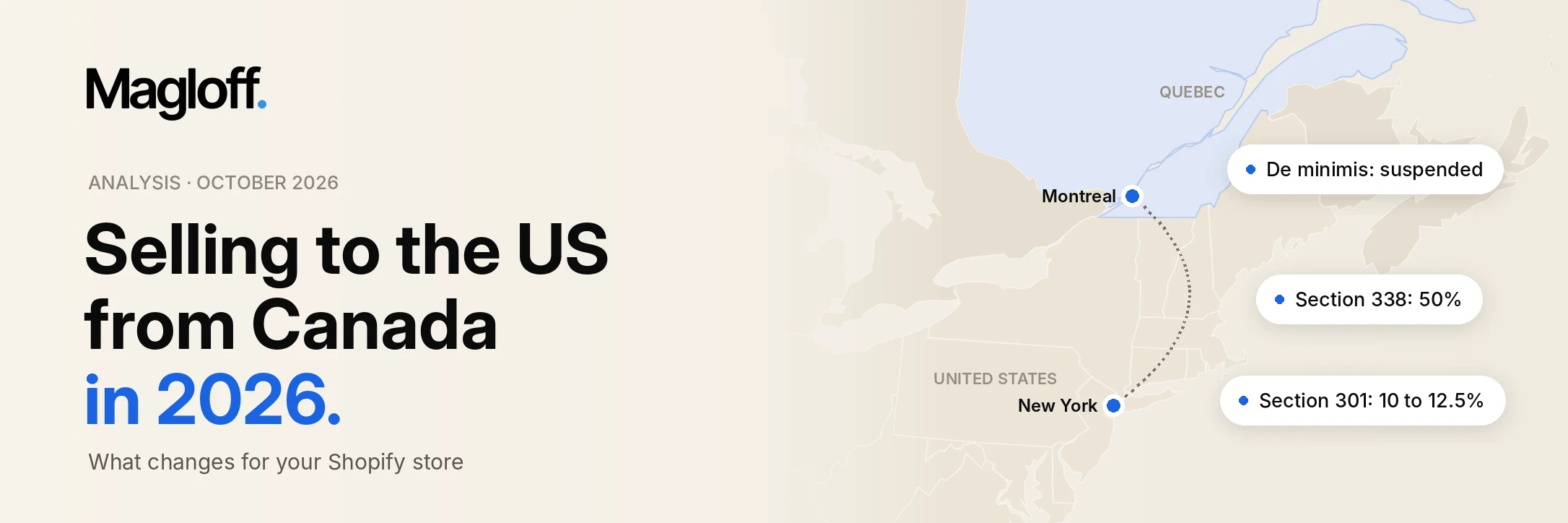
Your US orders still arrive, but something has changed. More refused parcels, more refund requests, customers discovering fees on delivery. Or simply US sales that stall, with no obvious explanation in your campaigns.
It is not just a feeling. Since summer 2025, the rules for shipping a parcel from Canada to a US customer have changed several times. Here is the essential, without customs jargon, and what it changes in a Shopify store.
What changed in a year?
Four dates sum it up, and a fifth is already set.
- August 29, 2025
The US$800 threshold disappears
Parcels to the US no longer enter duty-free. Every order can now pay duties, whatever its value.
Source: Thompson Hine - February 20, 2026
The Supreme Court strikes down some duties
Duties on non-CUSMA Canadian goods fall. A temporary 10% surcharge replaces them until July.
Source: WilmerHale - July 24, 2026
New forced-labor duties
10% to 12.5% depending on the country. CUSMA-compliant goods are exempt.
Source: Z2Data - August 22, 2026
A 50% surtax on a list of Canadian products
Alcohol, dairy, some furniture, leather products and textiles. This time, CUSMA compliance does not protect you.
Source: C.H. Robinson - July 1, 2027Coming up
The end of the threshold becomes permanent
A US law passed in 2025 makes the end of the exemption permanent.
Source: Thompson Hine
Add sector tariffs, which remain in place, for example on Canadian kitchen cabinets (Canadian Kitchen Cabinet Association). The result: two products from the same catalogue can be treated very differently. It all depends on each product’s tariff code and country of origin.
The problem does not show up in the books first. It shows up at checkout.
Why does the problem show up in the store first?
If duties are not paid at purchase, the customer pays them on delivery, often with the carrier’s brokerage fees on top. They discover an amount they did not expect, at the worst possible moment. What follows is predictable:
Refused parcels
The customer won’t pay at the door. You pay for the return.
Refunds
The customer asks back for the unexpected fees, or cancels.
Negative reviews
The surprise ends up on your listing, for everyone to see.
Abandoned carts
Customers who anticipate these fees don’t buy.
In your data, it looks like a drop in US conversion or campaign profitability. Yet the cause is neither the advertising nor the product page.
Should duties be charged at checkout or on delivery?
On delivery
- The customer discovers duties at the door
- Brokerage fees are often added
- Risk of refused parcels and refunds
At checkout
- The customer sees the final price before paying
- Shopify calculates duties, market by market
- Requires each product’s HS code and country of origin
Shopify can collect duties at checkout, show them as a separate line or include them in the price. Your carrier must support delivered duty paid labels (Shopify). A duties-included price reassures, but weighs on margin if prices have not been reviewed. It is a commercial decision as much as a technical one.
Ship from Canada or stock inventory in the US?
Ship from Canada
- Duties paid parcel by parcel
- Cost varies from order to order
- No inventory to move
Stock in the US
- Duties paid once, when inventory is imported
- More predictable cost
- Dedicated inventory, local returns, US taxes to review
The second model only makes sense above a certain volume (MNP). It depends on the catalogue, the margins and the share of US sales.
What should you check in your Shopify store?
These are the points I look at on a store that sells to the US.
- HS code and country of origin on every product
- Duties collected at the US checkout, or discovered on delivery
- US dollar prices that account for duties
- Clear US shipping terms on product pages
- Products hit by the 50% surtax identified
- US campaigns judged on margin after duties
- Shipping and taxes up to date in the US Merchant Center feed
- US returns planned
Each of these points is quick to check. Knowing which ones cost your store the most is another matter.
Frequently asked questions
Does the US$800 threshold still apply to Canadian parcels?
No. It has been suspended for all countries since August 29, 2025, and a US law sets its permanent repeal for July 1, 2027.
Does a CUSMA-compliant product enter the US duty-free?
Not always. CUSMA compliance exempts goods from forced-labor duties, but not from the 50% surtax if the product is on the covered list, nor from sector tariffs.
Should duties be charged at checkout or on delivery?
Collecting duties at checkout avoids the bad surprise on delivery, which can cost a refused parcel, a refund or a customer. The right setting depends on your margins, volumes and carriers.
Will these rules change again?
Probably. Postal shipment rules are set to change on January 20, 2027, the statutory repeal of the threshold is scheduled for July 1, 2027, and CUSMA is under review. For product classification, a customs broker remains the reference.
A customs issue that gets solved in the store
The end of the threshold and the new duties are not just a logistics matter. They change the final price, the checkout, conversion and the profitability of US campaigns.
Every catalogue has its own exposure. The point is to know which products, which prices and which shipping model to review first, before investing more in the US market.
Situation as of October 22, 2026. This article is not legal or customs advice: classifying your products is a job for a licensed customs broker.
Sources
- Thompson Hine, CBP Issues Interim Final Rules Indefinitely Suspending the De Minimis Exemption for Imports
- WilmerHale, Supreme Court Strikes Down IEEPA Tariffs: What Now?
- Z2Data, How the Termination of Section 122 Tariffs Impacts Your Supply Chain
- C.H. Robinson, New 50% Section 338 Duties on Select Canadian Products
- Canadian Kitchen Cabinet Association, Update on US Tariffs applied to Canadian cabinet manufacturing
- Shopify, Collecting international duties and import taxes at checkout
- MNP, Navigating the end of de minimis: Strategies for Canadian businesses
- Zonos, U.S. Tariff Changes & Postal Duty Updates